
FUE (Follicular Unit Extraction) moves healthy hair follicles, one at a time, from the back and sides of your head to areas that are thinning or bald. Because no strip of skin is removed, there is no linear scar and recovery is quicker. Here is how it works, who it suits, and what to expect month by month.
★★★★★ Rated 4.88 by 400+ independent reviewers on Reviews.co.uk

MEDICALLY REVIEWED BY
F-ISHRS · ABHRS · IAHRS member · 25 years in hair restoration
6–8 hours
Typical procedure length, done in one day
Local anaesthetic
You stay awake and comfortable throughout
3–5 days
Before most people return to desk work
12–18 months
Until you see your full, final result
THE BASICS
An FUE hair transplant doesn't create new hair. It relocates your own. Healthy follicles are moved, one small group at a time, from where hair is plentiful to where it is thinning, and each one carries on growing in its new position.
Both the NHS and the American Academy of Dermatology describe hair transplantation the same way: hair is taken from the back of the head and moved to thinning areas. FUE is the method that removes that hair one follicular unit at a time, rather than cutting out a strip of scalp. Below is what happens at each stage, and why the results last.
THE SCIENCE
Male pattern hair loss is caused by genetics and a hormone called dihydrotestosterone (DHT). According to the British Association of Dermatologists, DHT makes affected hairs progressively thinner, shorter and lighter until the follicles stop producing visible hair. This usually happens at the hairline and on top of the head.
Follicles at the back and sides are far less sensitive to DHT. In 1959, dermatologist Norman Orentreich showed that these follicles keep their resistance after being moved, a principle known as donor dominance (Annals of the New York Academy of Sciences). It is the reason every modern hair transplant works.
THE BUILDING BLOCK
Hair doesn't grow as single strands. It grows in tiny natural groups called follicular units, each holding one to four hairs (ISHRS). FUE removes these units intact, then places them according to how many hairs they carry:
1 hair
The very front, for a soft, natural hairline
2 hairs
Just behind, to blend the hairline into density
3–4 hairs
The centre and crown, where fullness matters most
01
The donor area is trimmed to about 1mm. Using a micro-punch usually 0.8–1.0mm wide, the surgeon scores around each follicular unit and gently lifts it out. ISHRS clinical guidelines recommend the smallest punch that keeps grafts intact, to limit scarring.
02
Grafts are checked under magnification, sorted by the number of hairs, and kept in a chilled storage solution. Speed matters: studies show graft survival falls the longer grafts stay outside the body, by roughly 1% per hour (Sharma & Ranjan, 2019).
03
Tiny incisions are made in the thinning area at the angle, direction and density of your natural hair, and each graft is placed into one. ISHRS guidelines state these incisions should be made by a physician. Grafts are usually firmly anchored within 6–9 days.
Your supply of donor hair is limited and has to last a lifetime. ISHRS guidelines advise taking grafts only from the “safe donor area”, where hair is most likely to be permanent, and note that removing up to 40–50% of follicles in a zone shouldn't cause visible thinning. Taking more, or taking them unevenly, can leave the back of the head looking patchy.
A transplant restores hair where it has been lost, but it can't stop your remaining natural hair from thinning. The American Academy of Dermatology notes hair loss can continue after a transplant, and the NHS names finasteride and minoxidil as the main treatments for male pattern baldness. Dr. Tayfun may discuss these with you to protect your result.
Both methods move hair from the donor area to the thinning area. The difference is how the grafts are taken, and that affects scarring and recovery. As the ISHRS puts it, FUE leaves no linear scar, but it is not scarless.
FUE
FUT (strip method)
How grafts are taken
One by one with a micro-punch
A strip of scalp is cut out, then divided
Scarring
Tiny dot scars, hard to see once healed
One linear scar across the back of the head
Stitches
None
Yes, removed after 10–14 days
Short hairstyles
Possible once healed
Scar may show with very short hair
Back to desk work
Usually 3–5 days
Usually 1–2 weeks, with donor tightness
Offered at GetHair
Yes, Standard and No-Shave
No
Don't want to shave your head? Read about our No-Shave hair transplant, which uses the same FUE method while keeping your existing hair long.
You are our only patient that day, so nothing is rushed. Most procedures take 6–8 hours, including a lunch break.
01
Dr. Tayfun examines your scalp, confirms your graft count and draws your new hairline with you. Photos are taken and your hair is trimmed.
About 1 hour
02
The donor and recipient areas are numbed. You will feel the first injections, then very little. Many patients watch a film or doze.
About 15 minutes
03
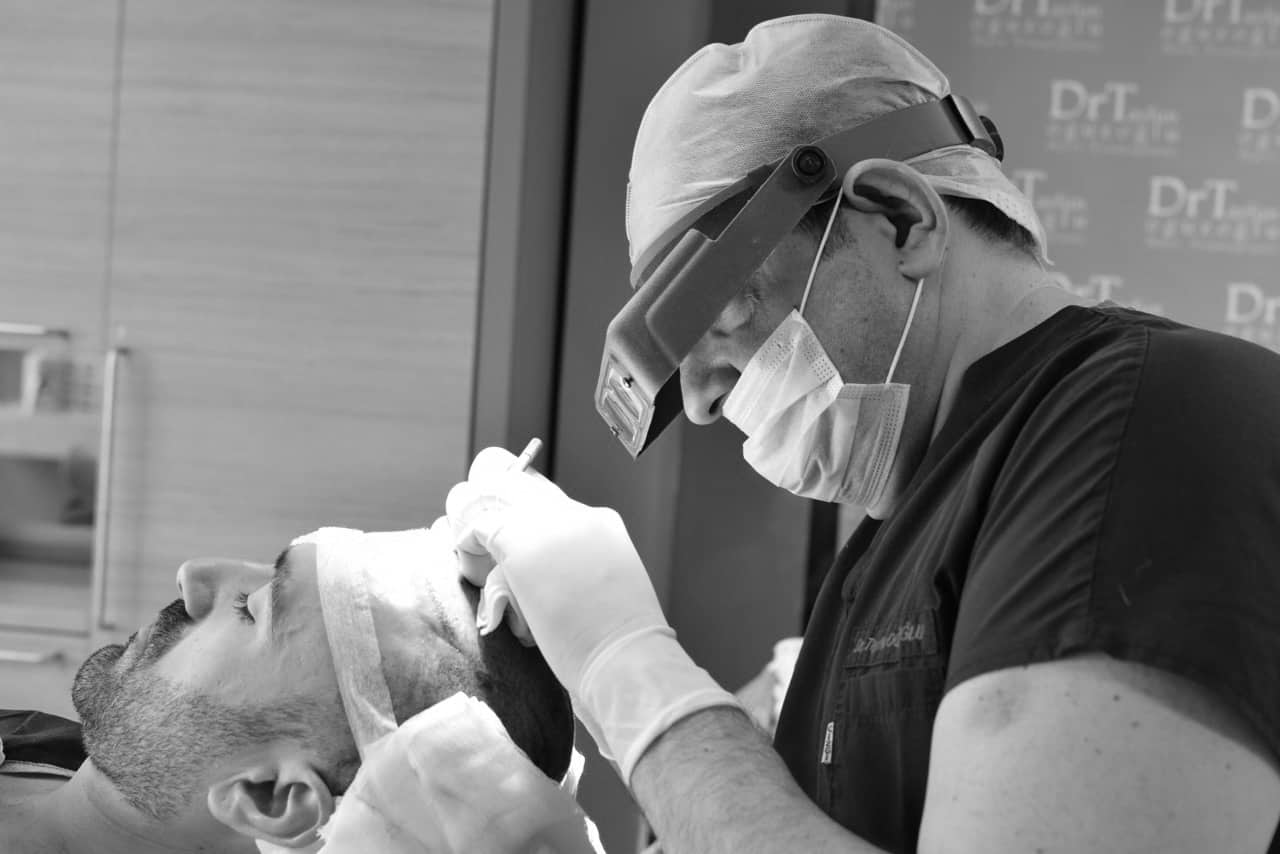
Dr. Tayfun removes each follicular unit with a micro-punch. The grafts are counted and kept in a chilled storage solution while you rest.
2–3 hours
04
Tiny incisions are made in the thinning area, following the angle and direction of your natural hair. This is what makes a hairline look natural.
About 1 hour
05
His team places each graft into the channels under his supervision. You leave with an aftercare kit and a clear plan for the days ahead.
2–3 hours
RECOVERY
Everyone heals a little differently. The timings below follow guidance from the American Academy of Dermatology and the ISHRS, and match what most of our patients experience. We follow up with you for 12 months.
Days 1–3
Mild swelling around the forehead is common and settles within a few days. Sleep with your head raised and take your medication as prescribed.
Days 4–10
Small crusts form around each graft and come away with gentle washing, usually within 7–14 days. Most people are back at desk work within 3–5 days.
Weeks 2–4
Redness fades to light pink. Most people can return to the gym after about two weeks and swimming after four, as advised by your surgeon.
Months 1–3
Between two and eight weeks after surgery, most transplanted hairs fall out. The AAD describes this as normal: the follicles stay in place and rest before they regrow. By month three your hair may look thinner than before, which is also expected.
Months 3–6
New hair starts to appear, fine at first. Some people get small spots as hairs break through the skin. These are temporary and a sign of growth.
Months 6–12
The biggest visible change. Hair thickens, lengthens and blends in with your existing hair. The AAD notes most patients see results between six and nine months after surgery.
Months 12–18
You see your final result. The crown often takes longer to mature than the hairline. Transplanted hair can be cut and styled like the rest of your hair.
FUE works well for most men with pattern hair loss, but not everyone is a good candidate right now. Dr. Tayfun assesses every patient individually and will tell you honestly if waiting or another option would serve you better.
✓ Your hair loss has stabilised or is progressing slowly
✓ You have enough healthy donor hair, and your scalp can still grow hair in the thinning area (AAD)
✓ You want to restore a receding hairline, a thinning crown, or both
✓ You want a natural result and understand it takes 12–18 months
• You are under 25 and your hair loss is still changing quickly. ISHRS guidelines advise caution because future loss is hard to predict
• Your donor area is thin, or your thinning is spread evenly across the scalp
• You have a medical condition that affects healing, which we will review with you
• You prefer a closely shaved look, where scalp micropigmentation may suit you better
BEFORE
✓ Stop blood-thinning medicines and supplements such as aspirin, ibuprofen, vitamin E and fish oil for 7 days, unless your doctor says otherwise
✓ Avoid alcohol for at least 3 days, and cut down on smoking as much as you can
✓ Skip coffee and energy drinks on the morning of your procedure
✓ Wear a button-up shirt so nothing pulls over your head afterwards
AFTER
✓ Sleep with your head raised for the first 3 nights
✓ Wash your hair exactly as shown in your aftercare session, starting the day after
✓ Avoid heavy exercise for 2 weeks and swimming for 4 weeks
✓ Keep your scalp out of strong sun for a month. A loose hat is fine
You'll receive a personal instruction sheet before you travel. Always follow your surgeon's advice if it differs from the general guidance here.
FUE is a low-risk procedure in experienced hands, but it is still surgery. Large clinical studies put the overall complication rate at 1.2–4.7%, and serious problems are uncommon (Frontiers in Medicine, 2026).
Swelling across the forehead affects nearly half of patients for a few days. Redness, crusting and temporary numbness in the donor area are also common. Some existing hair near the grafts may shed 2–8 weeks after surgery (shock loss) and usually regrows within about three months.
Inflamed hair follicles (folliculitis) affected about 12% of patients in a large study, and usually clear with treatment. Infection is reported in under 1% of cases, and long-lasting numbness in about 2% (Frontiers in Medicine).
Taking too many grafts, or taking them from outside the safe donor area, can leave the back of the head thin or patchy. ISHRS guidelines recommend spreading extractions evenly and protecting donor supply for life.
A poorly designed hairline or wrong graft angles. This is why who designs your hairline and makes your incisions matters more than the name of the technique.
FUE AT GETHAIR
Whichever you choose, Dr. Tayfun performs your extractions and incisions himself, and you are the only patient that day.
from £2,900
Your head is trimmed short. Best for larger sessions and more advanced hair loss.
See pricingfrom £3,400
Your existing hair stays long and hides the work while you heal. Best for hairline work and early to moderate loss.
About No-Shave FUEFree assessment
Send four photos and Dr. Tayfun will recommend the right option, your graft count and your exact price.
Get my assessmentSend four photos of your hair: front, top, crown and back. Within one business day, Dr. Tayfun sends your personal plan, graft estimate and price. It's free, with no obligation.
You will feel the local anaesthetic injections at the start. After that, most patients feel pressure rather than pain. Mild soreness for a few days afterwards is usually managed with standard painkillers.
Yes, but they are very small. FUE leaves tiny dot-shaped scars where each graft was taken, and the ISHRS is clear that FUE is not scarless. Once healed, the dots are very hard to see, even with short hair, though they can show with a very close shave. There is no linear scar.
Transplanted follicles come from areas resistant to hair loss, so the hair they grow is long-lasting. Your existing, non-transplanted hair can still thin with age. The AAD notes that medication can prevent or slow this, and Dr. Tayfun may discuss it with you.
Most patients need between 2,000 and 4,000 grafts, depending on the area being treated and how much donor hair you have. You'll get a personal estimate in your free assessment.
Most people with desk jobs return within 3–5 days. If you'd rather nobody notices, No-Shave FUE keeps the procedure much less visible while you heal.
Both remove grafts in the same way. DHI uses an implanter pen to make the incision and place the graft in one step, while FUE opens the channels first and implants afterwards. The skill of the surgeon affects your result far more than the tool.
This guide draws on guidance from UK and international medical bodies and peer-reviewed research.
NHS. Hair loss.
British Association of Dermatologists. Hair loss, male pattern (androgenetic alopecia): patient information leaflet.
American Academy of Dermatology. Hair transplant: what to expect.
International Society of Hair Restoration Surgery (ISHRS). FUE hair transplant: benefits, process and recovery.
ISHRS. FUE Clinical Practice Guidelines (2019).
Orentreich N. Autografts in alopecias and other selected dermatological conditions. Annals of the New York Academy of Sciences, 1959.
Sharma R, Ranjan A. Follicular Unit Extraction (FUE) Hair Transplant: Curves Ahead. Journal of Maxillofacial and Oral Surgery, 2019.
Romera de Blas C, et al. Complications in follicular unit excision hair transplantation: current evidence and practical approaches. Frontiers in Medicine, 2026.
Medically reviewed by Dr. Tayfun Oğuzoğlu, F-ISHRS · Last reviewed September 2026. This page is for general information and is not a substitute for a personal medical consultation.